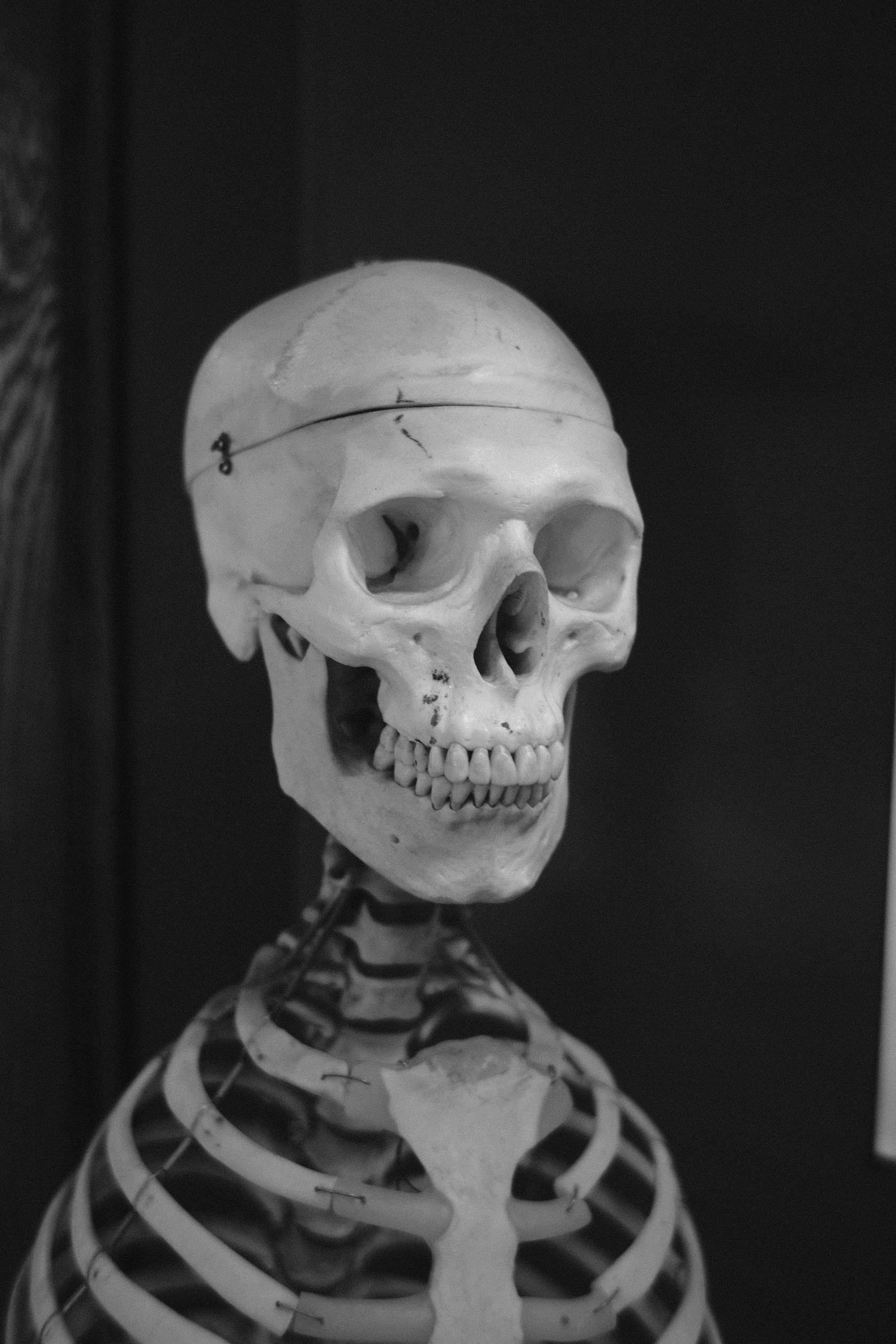
# The Skull (Joseph Theophilus)

<details id="bkmrk-this-line-will-be-vi"><summary>Preview:</summary>

This study examines the human skull, which forms the structure of the head and foundation of the face. My favorite bone group to draw—though I find its symbolism with death or witchcraft rather satirical.

</details>**Synonyms: Cranium; Braincase; Noggin; Head bone**

---

### **Summary**

The skull (Latin: Cranium) is a bone group made of 22 interlocking bones that protect the head. It houses and safeguards the brain, eyes, and inner ear. The skull has two main parts: the cranium which encloses the brain, and the facial skeleton which forms the face. It protects vital organs, provides attachment points for facial and chewing muscles, and supports sensory organs. The skull connects to the spine at the first neck vertebra for head movement, and to the lower jaw for jaw function in speech and eating.

#### **Basics**

The skull is a complex bone group that form's the protective casing for the brain and the structural framework of the face. From an anterior (front) view, you can see how different bones fit together like puzzle pieces, each with distinct shapes and colors in this study.

<span style="white-space: pre-wrap;">The cranial vault, shown in blue-green tones, includes the </span>**frontal bone**<span style="white-space: pre-wrap;"> forming the forehead and the </span>**parietal bones**<span style="white-space: pre-wrap;"> creating the rounded top of the skull. The </span>**temporal bones**<span style="white-space: pre-wrap;"> (in maroon/purple) sit on either side at the temples, housing the ear structures.</span>

<span style="white-space: pre-wrap;">The facial skeleton is equally intricate. The </span>**sphenoid bone**<span style="white-space: pre-wrap;"> (yellow, behind the eye orbits) acts as a keystone connecting many cranial and facial bones. The </span>**zygomatic bones**<span style="white-space: pre-wrap;"> (cheekbones, in yellow) give the face its width and form the outer edges of the eye sockets. The small </span>**nasal bone**<span style="white-space: pre-wrap;"> (yellow) forms the bridge of the nose, while the </span>**maxilla**<span style="white-space: pre-wrap;"> (upper jaw, in green-white) holds the upper teeth and forms much of the mid-face structure.</span>

<span style="white-space: pre-wrap;">Finally, the </span>**mandible**<span style="white-space: pre-wrap;"> (lower jaw, shown in turquoise) is the only movable bone in the skull, articulating with the temporal bones to allow for chewing, speaking, and facial expressions. Notice how it's completely separate from the rest of the skull, highlighting its unique mobility.</span>

[![AA1.jpg](https://www.anatomyarchive.org/uploads/images/gallery/2026-01/scaled-1680-/wKZaa1.jpg)](https://www.anatomyarchive.org/uploads/images/gallery/2026-01/scaled-1680-/wKZaa1.jpg)

#### **Connections**

The skull is considered a bone group because it's made up of multiple bones that are fused or joined together to protect the brain and sensory organs. These bones connect through fixed joints called sutures (in adults) or soft spots called fontanelles (in infants), which lock together like puzzle pieces to create a strong skull.

**Which other bones does the skull connect to?**

The skull connects to the spine at the first neck bone (atlas), which allows the head to nod up and down. It also connects to the lower jaw (mandible), which is the only movable joint in the skull and allows for chewing and talking.

[![c1 atlas.jpg](https://www.anatomyarchive.org/uploads/images/gallery/2026-01/scaled-1680-/1n3c1-atlas.jpg)](https://www.anatomyarchive.org/uploads/images/gallery/2026-01/scaled-1680-/1n3c1-atlas.jpg)

**Which important body parts or muscles connect to the skull?**

Many muscles attach to the skull, including:

- Chewing muscles that connect to the jaw and sides of the skull.(Temporalis and masseter)
- Neck muscles that connect to the back and base of the skull for head and neck movement(Suboccipital, SCM, Trapezius muscles)

[![temp,mass,scm.jpg](https://www.anatomyarchive.org/uploads/images/gallery/2026-01/scaled-1680-/tempmassscm.jpg)](https://www.anatomyarchive.org/uploads/images/gallery/2026-01/scaled-1680-/tempmassscm.jpg)

[![trapezius and suboccipital.jpg](https://www.anatomyarchive.org/uploads/images/gallery/2026-01/scaled-1680-/trapezius-and-suboccipital.jpg)](https://www.anatomyarchive.org/uploads/images/gallery/2026-01/scaled-1680-/trapezius-and-suboccipital.jpg)

- facial muscles that attach to various skull bones for facial expressions.

[![MUSCLES OF THE FACE.jpg](https://www.anatomyarchive.org/uploads/images/gallery/2026-01/scaled-1680-/muscles-of-the-face.jpg)](https://www.anatomyarchive.org/uploads/images/gallery/2026-01/scaled-1680-/muscles-of-the-face.jpg)

<span style="white-space: pre-wrap;"> </span>***for more information on muscles of the face (see previous page)***

#### **Functions**

**What is this bone / bone group used for? Why do we have it?**

The skull has three main jobs:

**Protection**<span style="white-space: pre-wrap;"> - It protects the brain, eyes, and inner ear from injury. The hard bone acts like a helmet for these delicate organs.</span>

**Structure**<span style="white-space: pre-wrap;"> - It gives the head its shape and provides a framework for the face and facial features.</span>

**Attachment**<span style="white-space: pre-wrap;"> - It provides anchor points for muscles used in chewing, facial expressions, and head movement.</span>

The skull also contains openings that allow nerves and blood vessels to pass through, connecting the brain to the rest of the body.

#### **How to draw the bone / bone group**

Whenever I draw anything, I usually break it down into really simple shapes, then add the details from there. The skull can also be broken down into really basic shapes. Here is a step-by-step process of how I draw the skull - hope this helps

Step 1: Start out by drawing a sphere or circle. The sphere here represents the cranium, which is 2/3 of the entire skull.

[![1.2.jpg](https://www.anatomyarchive.org/uploads/images/gallery/2026-01/scaled-1680-/1-2.jpg)](https://www.anatomyarchive.org/uploads/images/gallery/2026-01/scaled-1680-/1-2.jpg)

Step 2: Draw a straight vertical line through the center of the cranial mass (now highlighted in green). This helps with the positioning of the skull. The axis of this line is determined by the perspective of the skull. Introduce the jaw by extending the lines of the cranial mass.

[![step2.jpg](https://www.anatomyarchive.org/uploads/images/gallery/2026-01/scaled-1680-/step2.jpg)](https://www.anatomyarchive.org/uploads/images/gallery/2026-01/scaled-1680-/step2.jpg)

Step 3: Add a horizontal line across the cranial mass. This line represents the eye socket line, which lies halfway down the skull. Notice that this creates a "t" shaped line. The "t" line is the line of symmetry of the skull; the vertical line divides the skull into two equal parts.

[![step3.jpg](https://www.anatomyarchive.org/uploads/images/gallery/2026-01/scaled-1680-/step3.jpg)](https://www.anatomyarchive.org/uploads/images/gallery/2026-01/scaled-1680-/step3.jpg)

Step 4: Draw the key landmarks: the eye sockets, cheekbones (zygomatic arch/bone), teeth line, jaw angle, and nasal opening. Try not to draw every single bone—keep it simple. Then add details.

[![steps4.5.jpg](https://www.anatomyarchive.org/uploads/images/gallery/2026-01/scaled-1680-/steps4-5.jpg)](https://www.anatomyarchive.org/uploads/images/gallery/2026-01/scaled-1680-/steps4-5.jpg)

Step 5: Add more details.

[![step5.5.jpg](https://www.anatomyarchive.org/uploads/images/gallery/2026-01/scaled-1680-/step5-5.jpg)](https://www.anatomyarchive.org/uploads/images/gallery/2026-01/scaled-1680-/step5-5.jpg)

### **Advanced**

Applying the same steps, one can try drawing the skull in different angles or perspectives.

[![ad4.2.jpg](https://www.anatomyarchive.org/uploads/images/gallery/2026-01/scaled-1680-/ad4-2.jpg)](https://www.anatomyarchive.org/uploads/images/gallery/2026-01/scaled-1680-/ad4-2.jpg)

Add more details.

[![ad5.3.jpg](https://www.anatomyarchive.org/uploads/images/gallery/2026-01/scaled-1680-/ad5-3.jpg)](https://www.anatomyarchive.org/uploads/images/gallery/2026-01/scaled-1680-/ad5-3.jpg)

#### **Study Tips**

- **Simplify the structure**<span style="white-space: pre-wrap;"> - Start with basic shapes: sphere for cranium, wedge for face, box for jaw. Build complexity gradually.</span>
- **Key proportions**<span style="white-space: pre-wrap;"> - Eyes sit halfway down the skull. Nasal opening starts at two-thirds. Entire skull is roughly 3.5 "heads" tall including jaw.</span>
- **Key landmarks**<span style="white-space: pre-wrap;"> - Master the eye sockets (orbits), cheekbones (zygomatic arch), nasal cavity, and temporal lines. These define everything and translate directly to portrait work.</span>
- **Multiple angles matter**<span style="white-space: pre-wrap;"> - Side and three-quarter views teach structure better than front views alone. The profile especially reveals how much the face projects forward.</span>
- **Planes over details**<span style="white-space: pre-wrap;"> - The cranium is rounded; the face has angular planes. Understanding this distinction helps your rendering. Deep shadows in eye sockets and nasal cavity are your friends.</span>
- **Common mistakes to avoid**<span style="white-space: pre-wrap;"> - Placing features too high, making the cranium too small, drawing the jaw too narrow, and over-detailing before nailing proportions(always keep it simple).</span>
- **Best practice**<span style="white-space: pre-wrap;"> - Do timed studies: 2 minutes for gesture/overall shape, 10 minutes for proportions and major landmarks, 30+ minutes for detailed rendering. The quick studies train your eye faster than you'd expect.</span>

Use photo references initially, then graduate to studying real skulls or high-quality casts for true three-dimensional understanding.

<details id="bkmrk-everything-beyond-th"><summary>Everything beyond</summary>

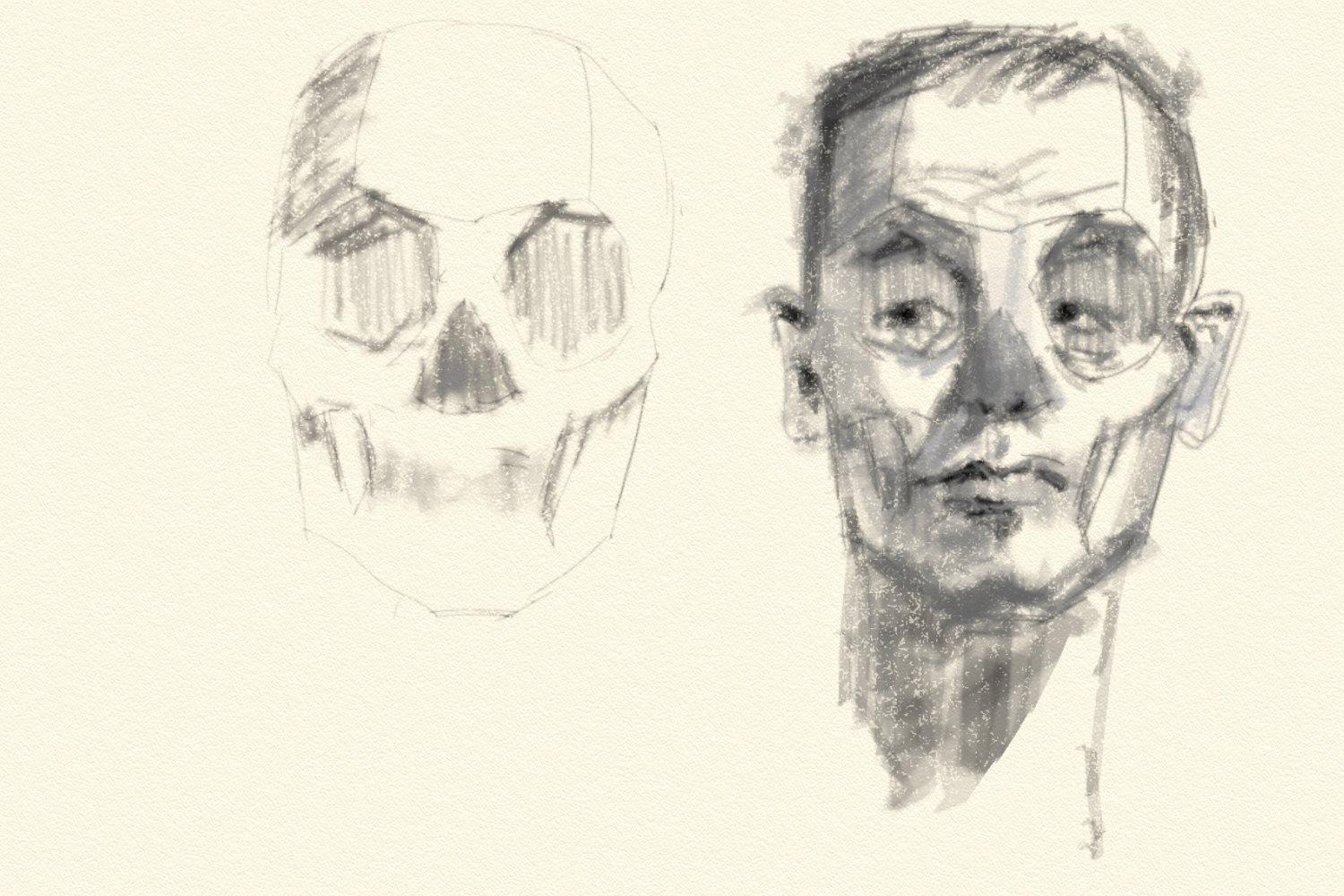
Understanding the skull shows you where features sit - eyes at mid-skull, nose length from nasal bone to upper teeth, cheekbone height from zygomatic arch width. The skull's flat surfaces (forehead plane, cheekbone plane, jaw plane) help you light faces right and create solid volume, which helps when drawing heads tilted, turned, or seen from weird angles without reference. Wide vs narrow skulls, big vs flat cheekbones, strong vs weak jaws create different faces and character designs, and knowing what's bone vs soft tissue helps you draw aging faces since the skull stays the same while skin sags. The skull is where facial muscles attach, so understanding brow ridges, cheekbones, and jaw structure shows you why expressions create certain wrinkles and shadows. Every face you draw is the skull plus soft tissue - learn the skull well, and you can build any head from imagination, making it the base of all portrait and character work.

[![after basic.jpg](https://www.anatomyarchive.org/uploads/images/gallery/2026-01/scaled-1680-/after-basic.jpg)](https://www.anatomyarchive.org/uploads/images/gallery/2026-01/scaled-1680-/after-basic.jpg)
</details>#### **Reference Pictures (for study only)**

<details id="bkmrk-name-the-source-%28web"><summary>from Reference.Pictures and Unsplash</summary>

[![jackson-wilson-B5Ddx7kx8yk-unsplash.jpg](https://www.anatomyarchive.org/uploads/images/gallery/2026-01/scaled-1680-/jackson-wilson-b5ddx7kx8yk-unsplash.jpg)](https://www.anatomyarchive.org/uploads/images/gallery/2026-01/scaled-1680-/jackson-wilson-b5ddx7kx8yk-unsplash.jpg)

[![anne-nygard-WKcwxlUV3iM-unsplash.jpg](https://www.anatomyarchive.org/uploads/images/gallery/2026-01/scaled-1680-/anne-nygard-wkcwxluv3im-unsplash.jpg)](https://www.anatomyarchive.org/uploads/images/gallery/2026-01/scaled-1680-/anne-nygard-wkcwxluv3im-unsplash.jpg)
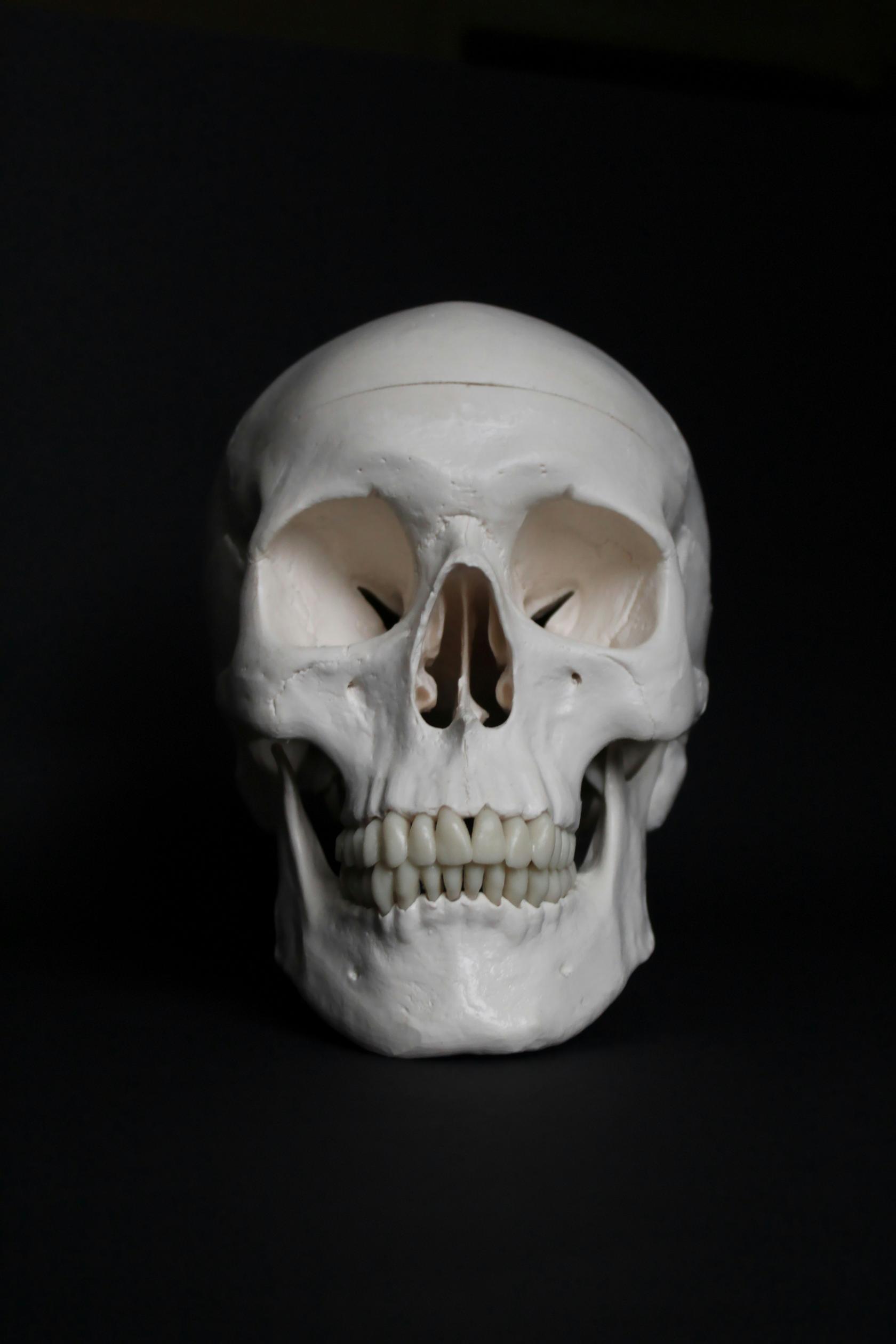
[![Reference-Pictures_Skull-123 copy.webp](https://www.anatomyarchive.org/uploads/images/gallery/2026-01/scaled-1680-/reference-pictures-skull-123-copy.webp)](https://www.anatomyarchive.org/uploads/images/gallery/2026-01/scaled-1680-/reference-pictures-skull-123-copy.webp)
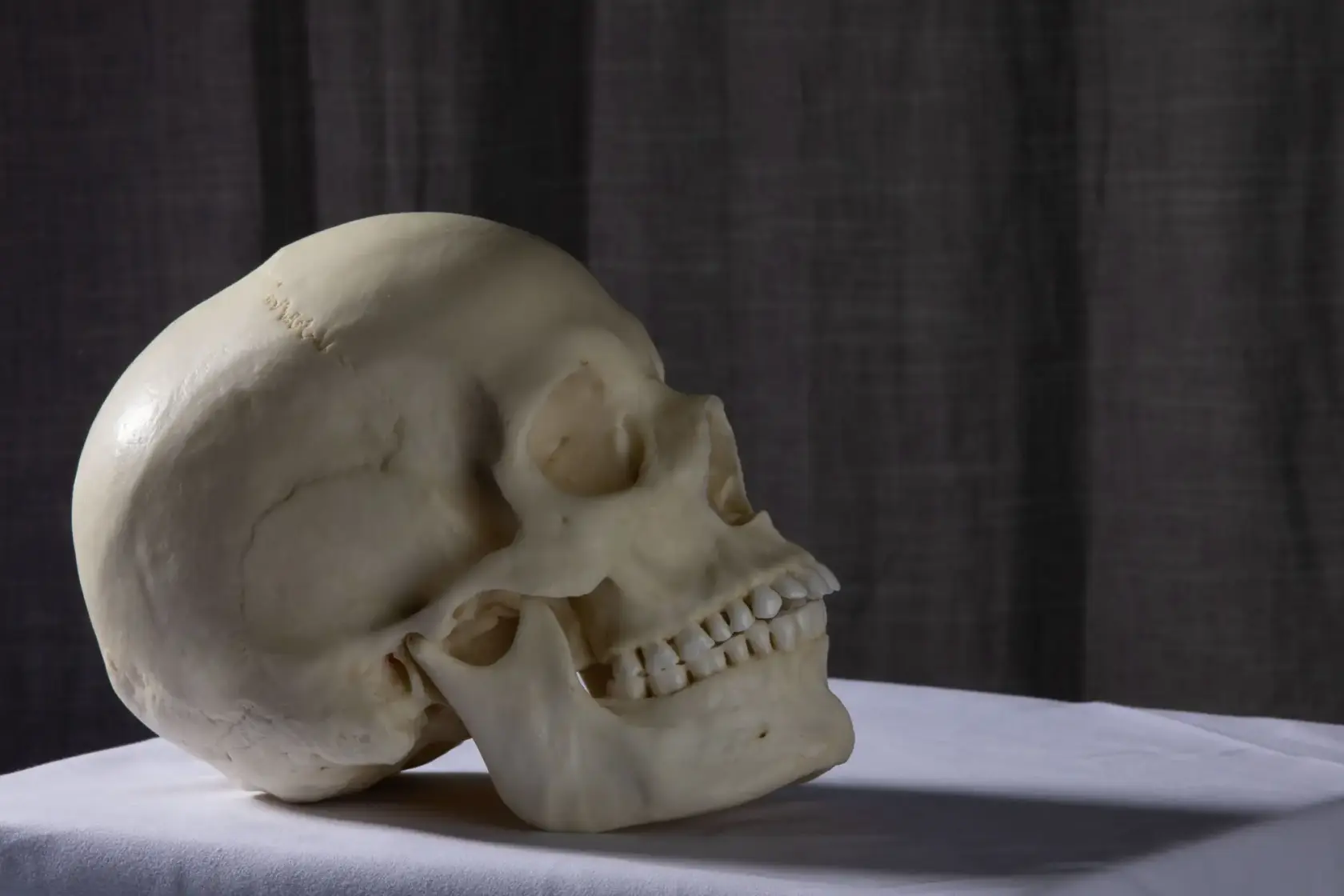
**credit to:** [**Reference.Pictures**](https://reference.pictures/ "Reference.Pictures")

[![Reference-Pictures_Skull-620 copy.webp](https://www.anatomyarchive.org/uploads/images/gallery/2026-01/scaled-1680-/reference-pictures-skull-620-copy.webp)](https://www.anatomyarchive.org/uploads/images/gallery/2026-01/scaled-1680-/reference-pictures-skull-620-copy.webp)
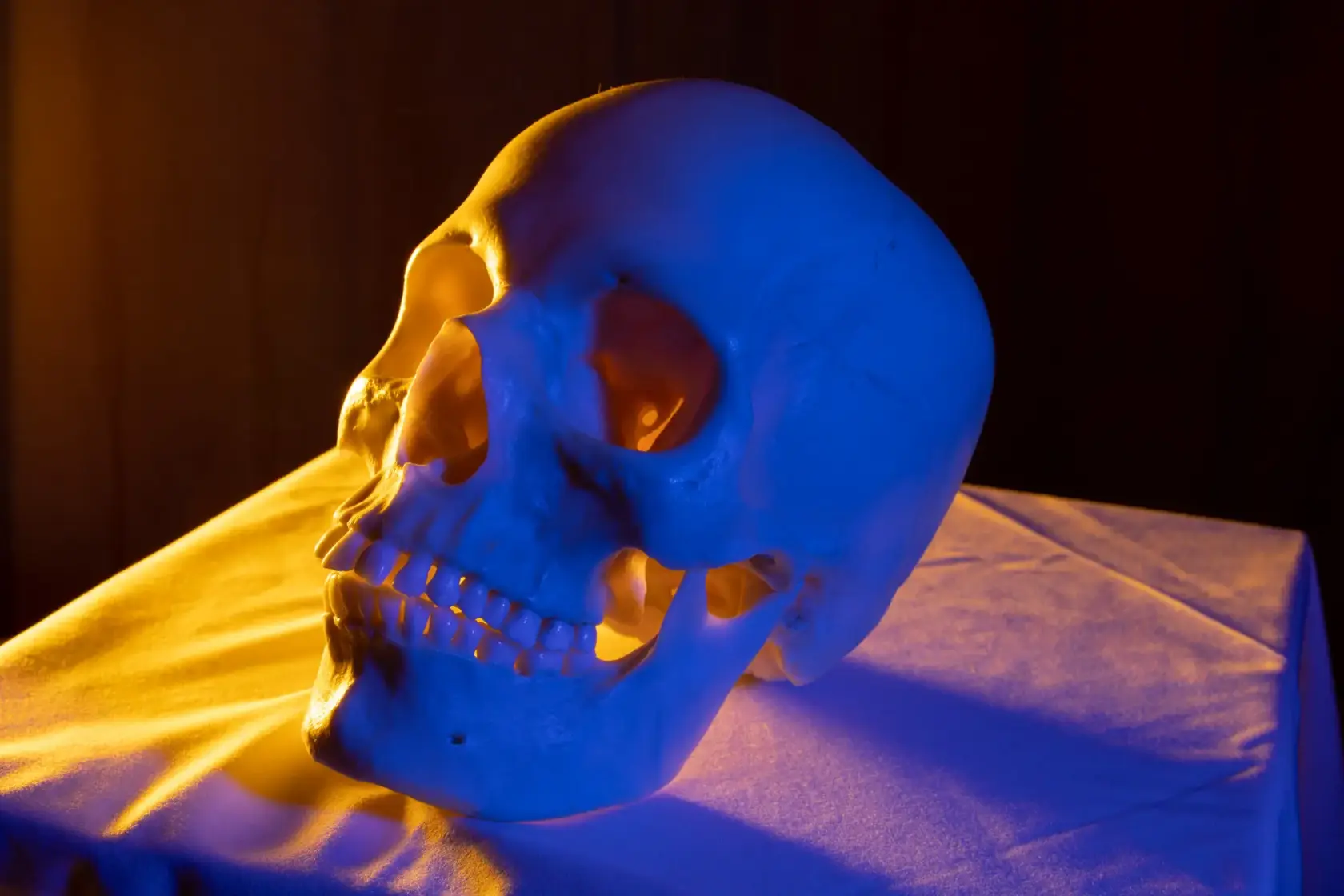
**credit to:** [**Reference.Pictures**](https://reference.pictures/ "Reference.Pictures")

[![Reference-Pictures_Skull-461 copy.webp](https://www.anatomyarchive.org/uploads/images/gallery/2026-01/scaled-1680-/reference-pictures-skull-461-copy.webp)](https://www.anatomyarchive.org/uploads/images/gallery/2026-01/scaled-1680-/reference-pictures-skull-461-copy.webp)
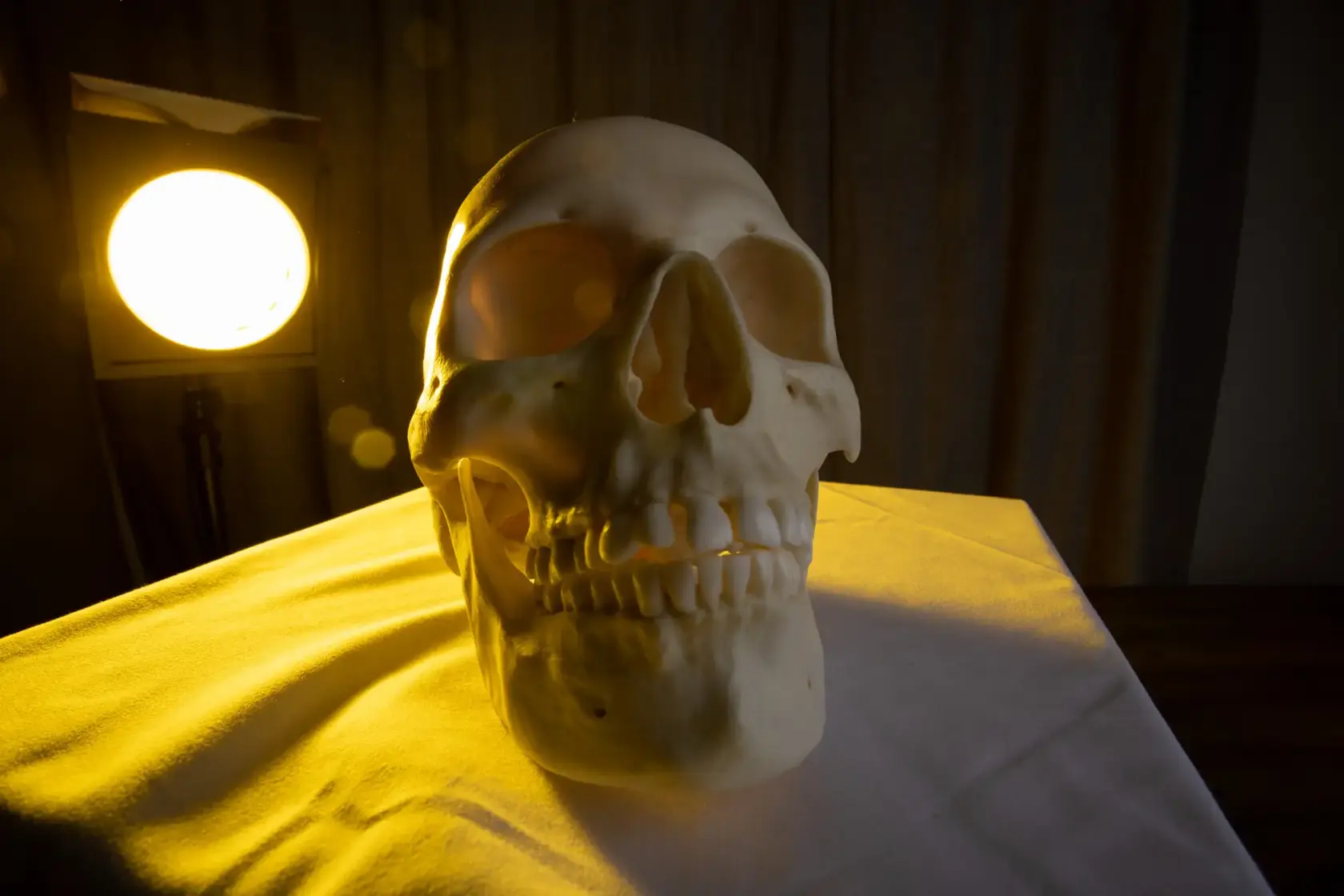
**credit to:** [**Reference.Pictures**](https://reference.pictures/ "Reference.Pictures")

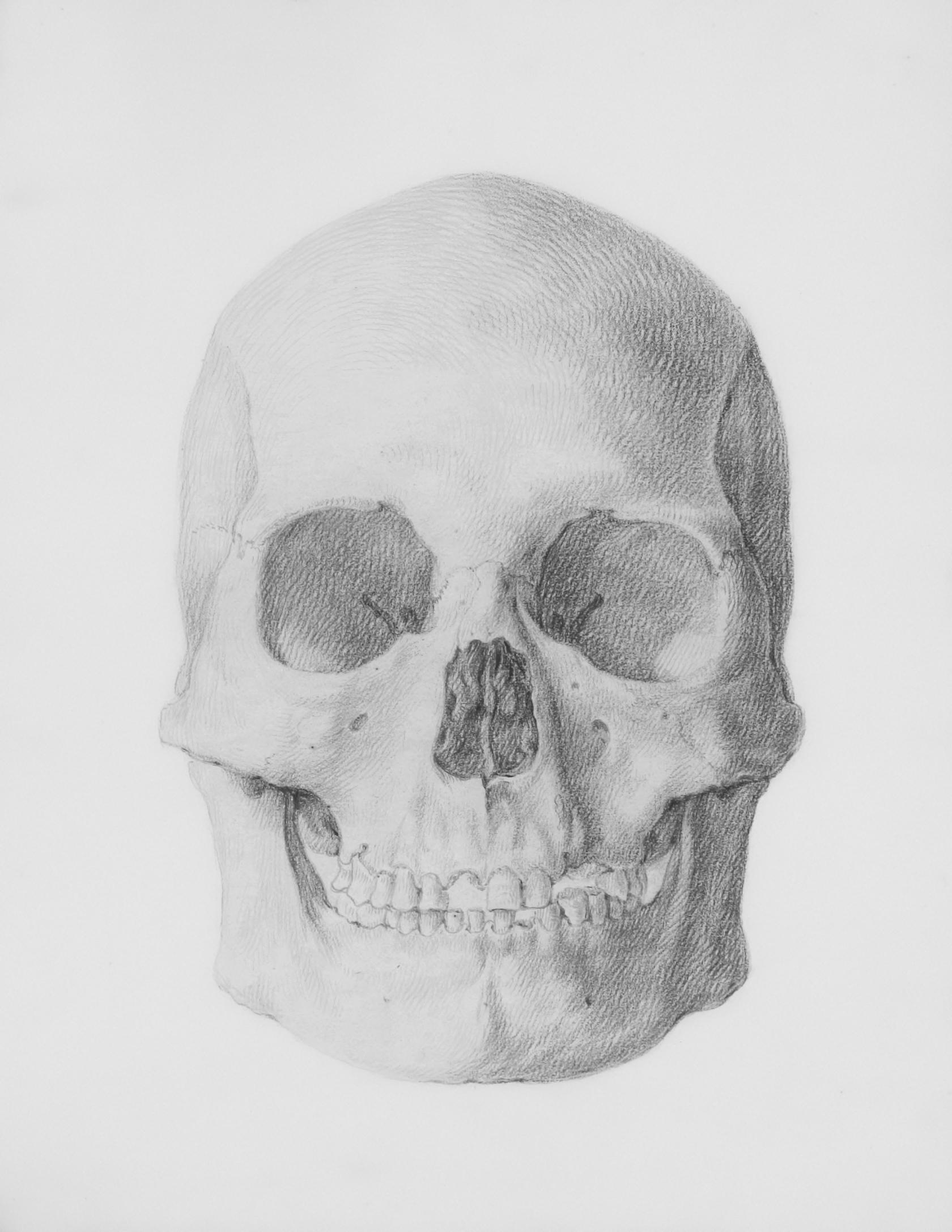
[![europeana-4lbwZ7vaEhA-unsplash.jpg](https://www.anatomyarchive.org/uploads/images/gallery/2026-01/scaled-1680-/europeana-4lbwz7vaeha-unsplash.jpg)](https://www.anatomyarchive.org/uploads/images/gallery/2026-01/scaled-1680-/europeana-4lbwz7vaeha-unsplash.jpg)
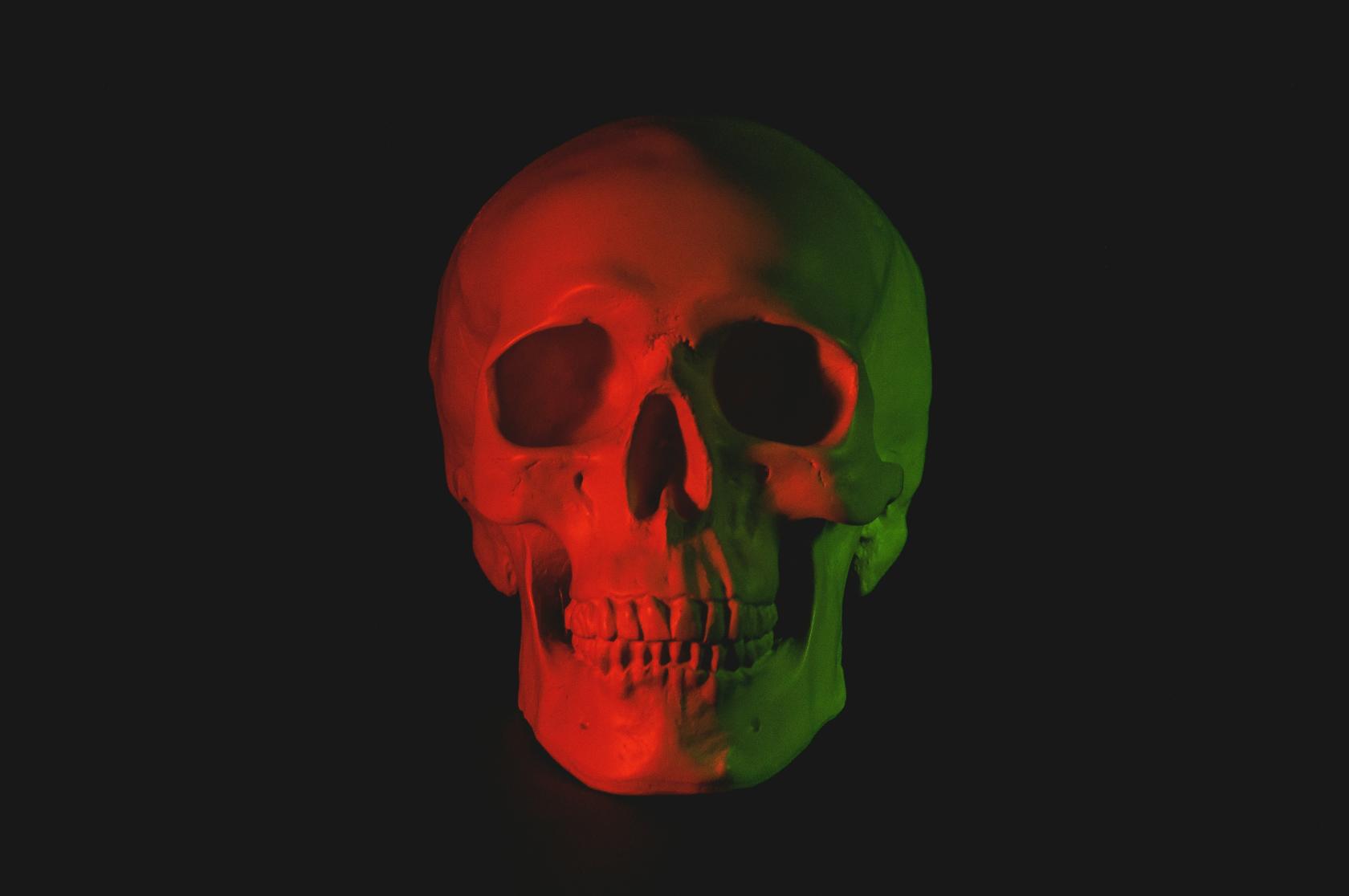
[![lina-white-K9nxgkYf-RI-unsplash.jpg](https://www.anatomyarchive.org/uploads/images/gallery/2026-01/scaled-1680-/lina-white-k9nxgkyf-ri-unsplash.jpg)](https://www.anatomyarchive.org/uploads/images/gallery/2026-01/scaled-1680-/lina-white-k9nxgkyf-ri-unsplash.jpg)
</details>